Pest guide · Meridian, Idaho
Trailing Ants Along Meridian Laterals, Slabs, and Kitchen Edges
- Reviewed by a licensed Idaho pest professional
Most kitchen trails in Meridian come from small brown-to-black ants, usually odorous house ants. They are after food and water, not looking for a fight, and the University of Idaho’s regional ant publication places the species throughout the Pacific Northwest (PNW 624). On this bench, those trails often start outdoors at irrigation laterals, leaky valves, and the still-settling slabs of new subdivisions, or at foundation cracks in older downtown bungalows. A licensed professional can follow a trail to its nest rather than treating only the workers on the counter.
Why Meridian kitchens see so many trailing ants
Water is the first draw. Meridian summers are typically dry, but pressurized urban irrigation in many new subdivisions, plus laterals managed by the Nampa-Meridian and Settlers Irrigation Districts, keep a ribbon of moisture along yards, easements, and park edges. Ants use that moisture, then follow expansion joints, irrigation sleeves, and slab edges into garages and kitchens.
Food is the second. A city that has filled former farmland with houses, trash enclosures, pet bowls, and packed pantries gives trailing ants a year-round pantry of their own. Species identification matters, because a bait or approach that works on one ant can fail on another.
How to recognize the usual kitchen ant
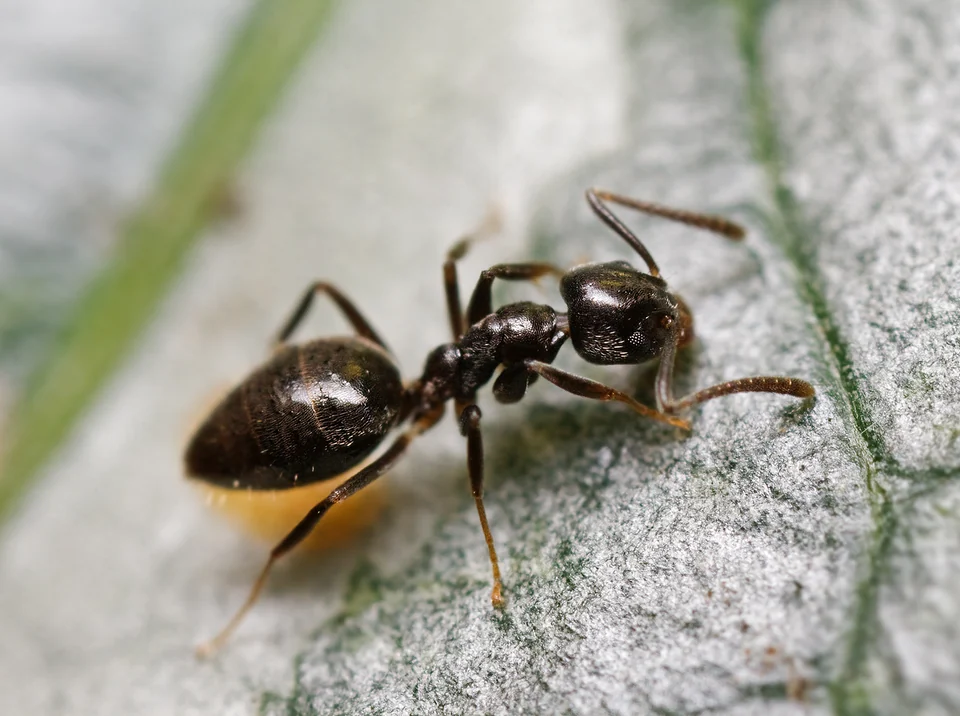
- Size and color. Workers are typically 2.5 to 3.5 mm long and uniformly brown to black.
- Odor when crushed. Disturbed odorous house ants often release a rotten, coconut-like smell, which is how they got the name (PNW 624). Several ants smell similar, so odor alone is not a sure identification.
- Trail habits. They travel along edges, corners, limbs, and wires, favor sweets, and may run erratically with the abdomen raised when alarmed.
- Nests. The regional publication notes outdoor and indoor nesting, including under bark and logs and inside houses. In Meridian, look first to damp soil along laterals, landscape timber, and voids near slabs — not to a river beach the city does not have.
- Mostly a nuisance. Odorous house ants do not typically damage wood. The issue is persistent trails in food-prep areas, not structural injury.
When a trail is worth a professional look
Request a quote when ants come back after you have cleaned, when trails show up in more than one room, when you suspect a nest in a wall, or when ants are walking through food-prep areas. Following the trail is more useful than wiping workers off the counter and hoping the source disappears.
How a licensed applicator usually handles trailing ants
- Names the species, because nesting habits and bait response differ.
- Follows trails to entry points and nest sites, indoors and out, including areas opposite wall voids.
- Places bait on active trails. The Pacific Northwest Insect Management Handbook describes baits as the most useful approach against ants in a structure, especially odorous house ants, and notes that results take patience (PNW handbook). Workers need time to carry bait back to the colony.
- Avoids scattering the colony. Disturbing a nest, or using the wrong product, can cause a colony to split and relocate, which is one reason this work belongs with a licensed applicator.
Get a free quote from a licensed local provider
Recommended local provider
Quote requests from this guide are passed to a licensed local provider. ProGuard is a local, family and veteran owned company, licensed and insured. Treatments are family and pet safe.
- Local, family and veteran owned
- Licensed and insured
- Family and pet safe
- Free quote
- Serves Meridian, Idaho
Questions neighbors usually ask about ants
Why do the same ants reappear after I wipe the counter?
The workers on the counter are foragers. The nest is usually outdoors or in a void, connected by a trail along a joint, sleeve, or crack. Cleaning the surface removes the visible ants, not the colony that sent them.
Does Meridian irrigation actually matter for ants?
Yes. Laterals and pressurized urban irrigation keep damp soil close to houses through a dry summer. Trails often start at that moisture and follow hard edges into the building.
Are these ants dangerous?
Odorous house ants are mainly a nuisance. They can contaminate food if they walk through it, which is why trails in kitchens are worth attention, but they are not a typical medical emergency.
Will spraying the trail end the problem?
Killing only the foragers you see can leave the colony intact, and the wrong product can split a nest. A licensed professional usually relies on bait that workers carry home, then checks whether the trail actually stops.
Sources
- University of Idaho Extension, PNW 624, ants of the Pacific Northwest
- Pacific Northwest Insect Management Handbook, nuisance household ants
- Nampa-Meridian Irrigation District
- Settlers Irrigation District
Citations go to the university, agency or city record behind each fact.
Keep reading
Other pests in Meridian homes
Need help with a pest in Meridian?
Describe what you are seeing and request a free quote. Requests are passed to a licensed local provider.